







By Radman Abrishami (EE/III)
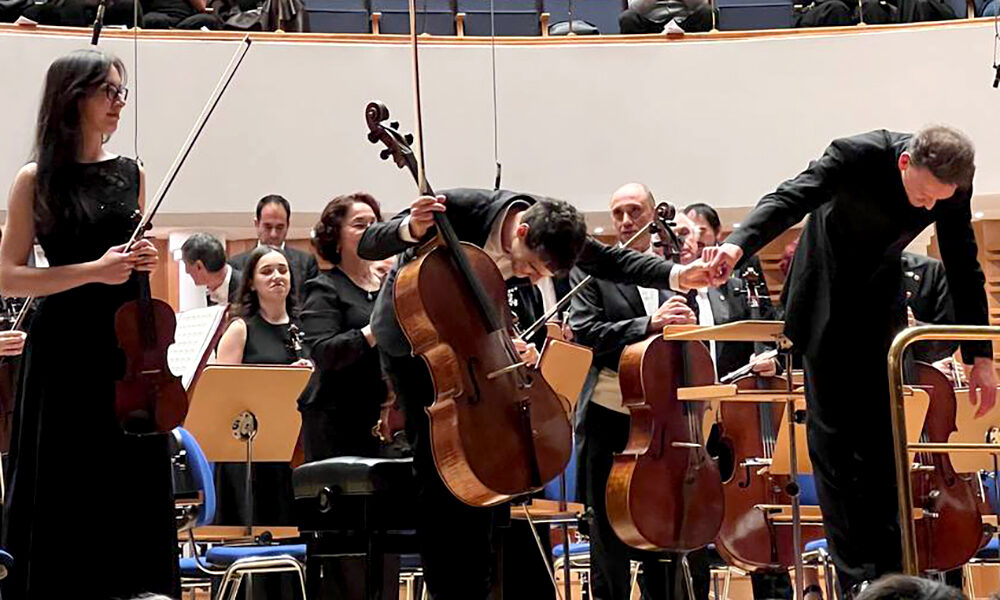
This is an informative and descriptive review of a Bilkent Symphony Orchestra classical concert that took place on November 29. The first work was Prokofiev’s Sinfonia Concertante, E Minor, Op.125 featuring Victor Julien Laferrière, a young yet professional French cellist. The second work was Tchaikovsky’s Symphony No.6, B Minor. The orchestra’s conductor was Moritz Gnann, an experienced German conductor.
Similar to Prokofiev himself, the concertante starts mystically, as it is in the early days of the modern period and everything is new and questionable, mystical yet energetic. Violins and violas follow Merve Birbir, the young and lively concertmaster assistant. Aerophones react to the chordophones’ call, a synced response with a deep depth generated by tuba’s sound. The music does not have an answer yet; the cello has a lot of vibratos and doubts. The cello jumps high and low, and bassoon’s low and flute’s high sounds are a continuous accompaniment.
Tubas and bassoons inform the passage through the unknowns with their low yet powerful pulses in the background. The soloist searches everywhere; sometimes flutes are high, violins are happy or double basses are blue.
Curiosity about a particular answer leads to the excitement of tubas, bassoons and double basses; some violins whisper in pizzicato mode and others answer melodically. Finding the correct answer is announced by the rising voice of the tambourine: All chordophones go as high as possible, aerophones add depth as they can and drums gallop toward the fest. The journey to reach the answer is full of epic, happy and tense moments created by the orchestra.
Dense emotional adventures make the cello speak fast like a spiccato, and the bassoons do not stop their drone. The last movement is full of energy. The full orchestra radiates their emotions and fills up the hall. We have arrived at the modern period after a long journey.
Tchaikovsky’s Symphony No.6 presents a vast spectrum of emotions. Perhaps the symphony is the Russian artist’s paradoxical emotions—the Western identity in his educational life or the traditional Russian presence. In any case, the symphony illustrates why the romantic era is called romantic. The way Tchaikovsky sets up the orchestra is like he is putting the music into the audience’s flesh and bones; your heart hears and your ears watch the music. The transitions from epic to happy or sorrowful moments are unbelievable. Sometimes the tubas and French horns are dominant, sometimes it’s the violins and violas. It is not clear whether the concertmaster’s hand is making music or it is dancing with it. The only thing that is clear is the conversation between the orchestra’s groups: violin 1, violin 2 and violas speak with one another in the most understandable sense. The percussionist follows the hand of the conductor for the exact moment to hit the cymbal and gong. The definition of the orchestra is engraved within this piece of art. The harmony of the sound sources, the textures of the music and the role of each group define the orchestra perfectly. The third movement is played so epically that at some point, all the violin and viola’s bows rise straight and bow together to the artist.
Even the audience could not wait until the end of the symphony and applauded cheerfully right after the movement.