




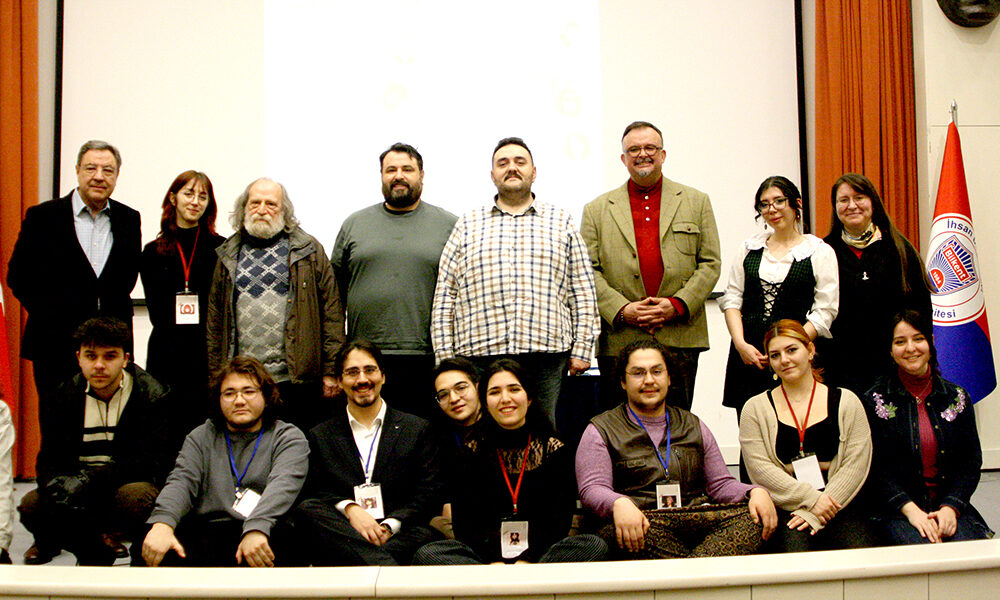

Bilkent University hosted the third annual “Possible Worlds: Storytelling, Mythology and Art Conference” on February 21–22, bringing together academics, writers and content creators to explore myth as a space for reimagining reality. Organized by the Historical Society, Literature Society, Science Fiction and Fantasy Society, Storytelling and Mythology Society and Translation Society, with the support of Oğuz Tansel Center for Turkish Literature (OTTEM), the Department of History and the Department of Translation and Interpreting in English and French, the two-day event examined how mythology and narrative shape cultural, intellectual and artistic production.
Originally launched in 2024 under the title “Mythos, History and Art Meeting,” the conference has evolved into a larger interdisciplinary platform. This year’s theme, “Possible Worlds,” framed myth not as mere escapism but as a creative and critical tool through which individuals and societies construct alternative ways of thinking and being.
The first day started with an opening talk by Duygu Duman from the TRIN Department. It featured discussions spanning science fiction, artificial intelligence, horror literature and fantasy world-building. Thomas Zimmermann opened the conference with a lecture on Frank Herbert’s Dune, focusing on its subtle warnings about artificial intelligence and technological disaster. Zachary Murphy King followed with a presentation on translation, modernism and literary debates in the Soviet Union, highlighting how Western writers were interpreted within socialist cultural frameworks.
Later sessions turned to horror and fantasy. Authors Mehmet Berk Yaltırık and Galip Dursun discussed the relationship between horror literature and social reality, emphasizing the genre’s engagement with cultural memory and fear. They were followed by a panel on Tolkien’s Middle-earth by Zafer Güleç, Berkay Ündeğer and Elçin Parçaoğlu. This panel examined myth, language and ethical imagination, demonstrating how fantasy literature constructs complex moral and philosophical worlds.
The final session of the first day addressed the adaptation of Turkish mythology into contemporary gaming. Bartu Bölükbaşı and Fatih Şahinbaş presented their tabletop war game “Warlords of the Steppes” as an example of how traditional mythological elements can be reinterpreted within modern strategy games, bridging cultural heritage and digital creativity.
The second day shifted toward historical and anthropological perspectives. Writer, instructor and editor Kudret Emiroğlu reflected on cultural history and collective memory, while N. İlgi Gerçek explored Hittite mythology and Late Bronze Age Anatolia within broader social and political contexts.
In a panel titled “Collaboration in Myth Production: Roleplaying Games,” Arya Zencefil, Mert Günhan and Berna Ece Gündüz examined tabletop role-playing games as spaces of collective storytelling and modern myth production. They discussed how shared imagination, narrative design and community practices contribute to the creation of new mythic structures for participants of RPGs.
The conference’s last panel was by Nehir Narin, who addressed the question “Is Human Nature Good or Evil?” through an interdisciplinary lens that combined anthropology, philosophy and popular culture. Her talk invited participants to reconsider one of humanity’s most enduring debates.
The event ended with a closing speech by Mehmet Kalpaklı from the History Department.
In recognition of each speaker’s contribution, saplings were donated to the Kulubaba Forest in Elazığ through the TEMA Foundation.
Over two days, the “Possible Worlds” conference demonstrated that myth and narrative are not confined to literature alone. Rather, they remain powerful tools for understanding society, culture and the human condition in historical and contemporary contexts.