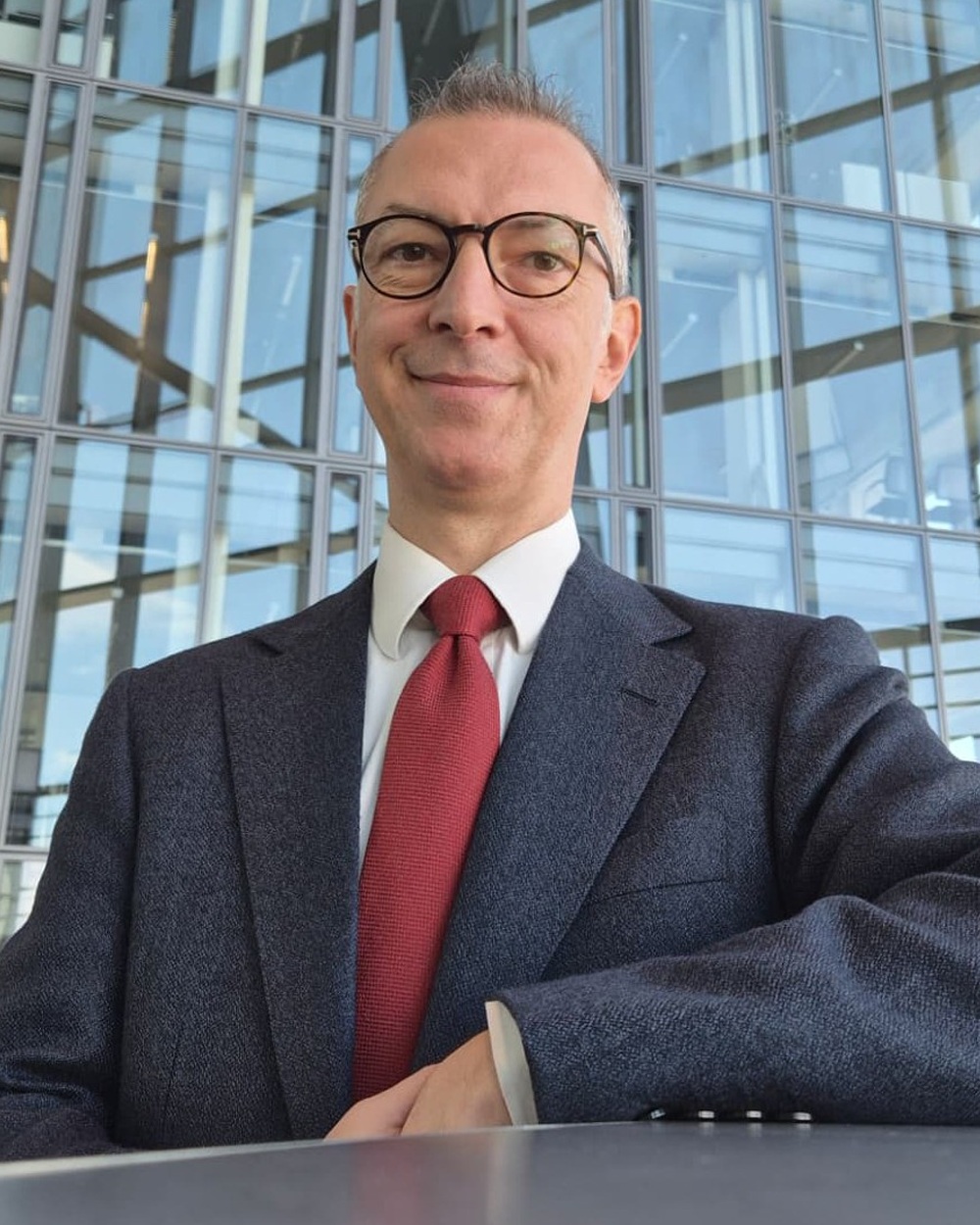



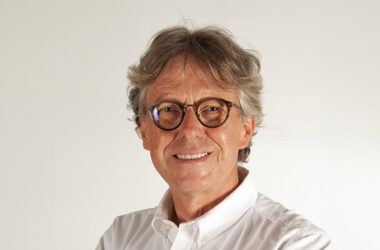

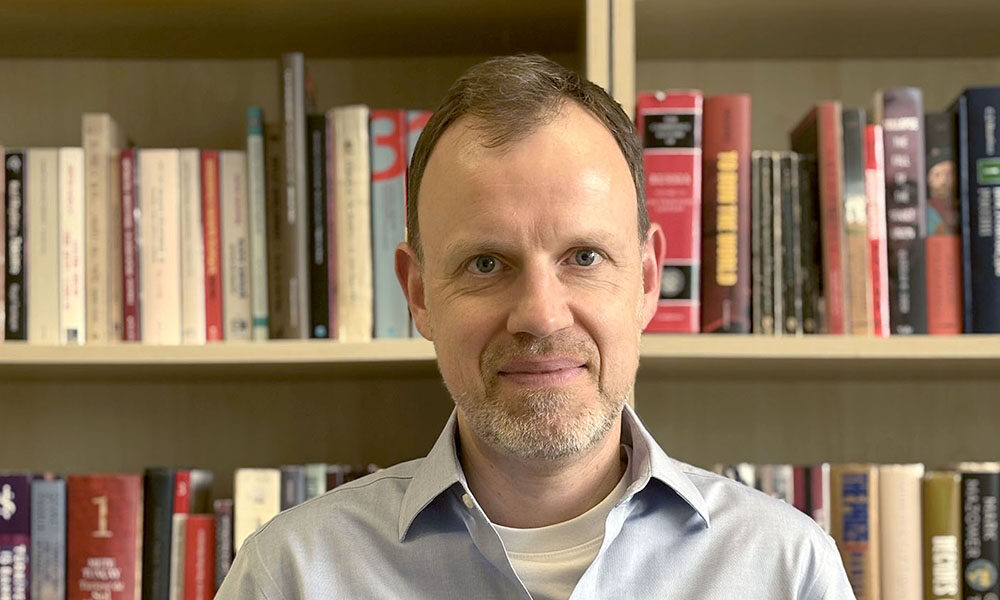
Assoc. Prof. Sam Hirst is a faculty member in the Department of International Relations, where he has been teaching since 2017. He received his BA in history from Washington University in St. Louis and later completed his MA and his PhD, both in history, at the University of Pennsylvania. He is the author of “Against the Liberal Order: The Soviet Union, Turkey, and Statist Internationalism, 1919–1939,” published by Oxford University Press in 2024. The book received the European International History Prize (between 1923 and 2024, this was the George Louis Beer Prize) from the American Historical Association, as well as the Marshall Shulman Prize from the Association for Slavic, East European and Eurasian Studies. Together with Assoc. Prof. Onur İşçi, he is co-author of “Kızıl Yıldız: Sovyetler Birliği Tarihi,” a Turkish-language popular history of the USSR (Kronik Kitap, 2025). He has published numerous articles in area studies journals such as Slavic Review and Turkish Studies, and also in general interest journals like Diplomatic History and Contemporary European History. At Bilkent, he regularly teaches two required courses in the IR curriculum: IR 205 Diplomatic History and IR 236 20th-Century World Politics. On occasion, he teaches electives on narrower themes in 20th-century international history (including liberal internationalism, decolonization and the Cold War).
Why did you choose an academic career?
I chose first to become a historian. Only later did I decide to become an academic. From an early age, I had two passions: literature and politics. In high school, I dabbled in creative writing, but I didn’t find enough politics in my classes. I then wondered about applying myself to economics, but the modern textbooks had too many equations. History seemed to me a happy medium: a deeply political science whose power rests on the appeal of its narrative.
What excites you about your work? And what is the coolest thing about your work?
There are a handful of archival discoveries that I can still remember. If we’re to speak about excitement, it’s hard to compete with the sense of elation upon finding a handwritten 1923 letter from the Soviet ambassador in Ankara to the foreign commissariat in Moscow that spoke to the broader intellectual questions I had articulated in a classroom on the other side of the world. For roughly five documents, I can vividly recall the room, the time of day and the feeling when I first held them in my hands. A couple of these documents answered questions that I had already formulated, but others forced me to ask new questions. Perhaps the coolest thing about being a historian is the sense of creating meaning from intimate but messy records that are open to multiple interpretations.
What’s the most common misconception about your work?
That history repeats itself. Without question, the past is one of the most powerful tools for understanding the present. In moments of crisis, human beings generally look for precedent. Currently, we hear: what does the 1973 Oil Crisis suggest we should expect from a closure of the Straits of Hormuz? Too often, however, a casual approach to history narrows our sense of the possible.
Earlier I referred to history as a science, and some might object. After all, any individual narrative is dependent upon an author’s distinctive voice. Yet, collectively, historians work to temper the facile comparison, to insist that historical facts be treated in context. Historians ask: what lines of inquiry have proved most fruitful for understanding the 1973 Oil Crisis, and how can we reformulate those questions for our moment, a moment that is very different than the world of the 1970s? When approached with the methodological rigor of an academic discipline, history has the power to expand our sense of the possible.
What’s your best work?
Historians don’t have a lot to choose from. The research and writing of “Against the Liberal Order” took years. I won’t have anything to compare it with until I finish my next monograph.
What projects are you working on currently?
My current project is a story of sovereign debt and death, of adultery and taxation. In addition to conducting research in Turkey, I have consulted archives in Berlin, DC, London and Moscow to reconstruct a history of global capitalism in the late 1950s. I’m interested in recovering some of the international economic rivalry that simmered beneath the ideological divisions of the Cold War.
If you had unlimited funds, what would you like to do research on?
For me, funding is less of an issue than time. I like my current project, but if there were a funding genie who could magically reduce the days I spend grading handwritten mid-terms, that would make me very happy.
What subject do you most enjoy teaching, and why?
That’s a bit like asking a parent of three to name their favorite child. Even if I had a preference right now, I shouldn’t voice it. I can say that all the courses I teach are expansive in their scope. I enjoy roaming across broad chronologies, thinking about moments of rupture and change in world politics.
Can you share a student interaction that has stayed with you over the years?
I like to think that I remember all of the students who ask questions in the classroom. Perhaps not the questions themselves, and occasionally a name might escape me, but if a student regularly asks questions, their face and their voice stay with me. Without questions from students, I’m not sure that I could teach. The questions signal to me what has truly engaged the class, what I’ve communicated effectively and where I need to improve.
What do you like the most about being at Bilkent?
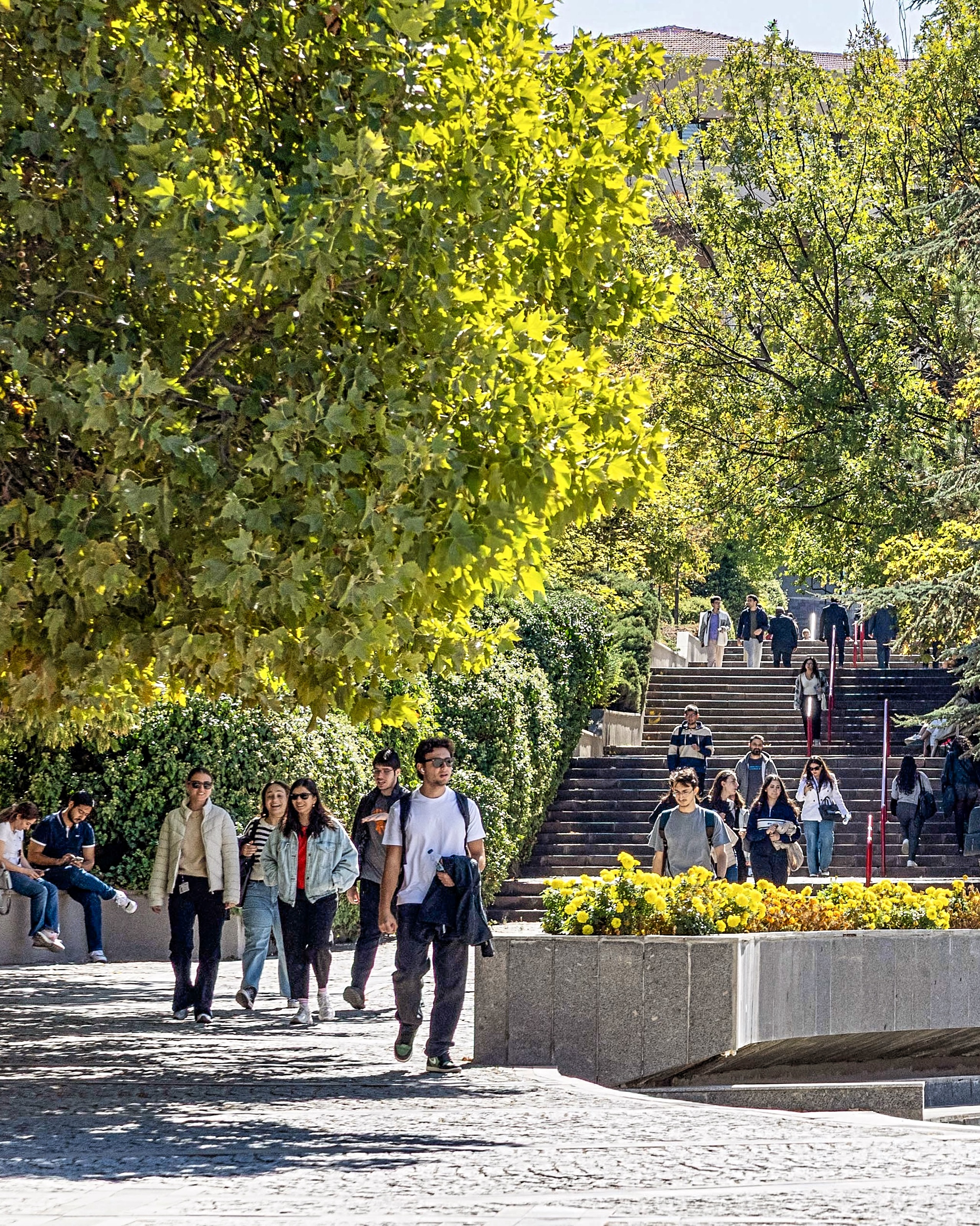
I first came to Bilkent as an undergraduate exchange student in 2002. I visited a couple of times, once to deliver an invited lecture at the IR department and later to witness the birth of a friend’s twin daughters, before returning to teach in 2017. Some of my oldest friendships began here, and it’s impossible for me to disentangle the personal and the academic. At this point, I appreciate the familiarity.
If you weren’t an academic, what career would you choose?
Some form of agriculture. Ongoing environmental degradation and the mechanization of white-collar labor lead me to think that there will be strong demand for high-quality produce.
What do you like to do when you are not working?
This is a difficult question for me to answer. I love cooking, gardening and bicycling. But I’m not sure that I would classify any of them as “not working.” Often, when I am wrestling with a sentence or struggling to express an idea, I sit for hours in vain in front of my computer. And then, when I take off the pressure and allow my mind to wander, the elusive words come to me as I’m weeding. Perhaps true “not working” is watching Liverpool FC.
Which book has influenced you the most, and why?
There are so many! I suppose I could say Jochen Hellbeck’s “Revolution on My Mind,” although it’s as much a question of when I read the book as the topic or approach. Hellbeck studied diaries written in the Soviet Union in the 1930s and sought to understand how politics penetrated the thoughts of Soviet citizens. I read the book in my first year of graduate school, prior to its publication. A mutual acquaintance had given me the galleys, and so, even though I had not yet met Hellbeck, there was a sense of personal proximity. He writes well, and the subject was close enough to my own that I was able to think to myself: I’d like to write a book that reads like that.
If you could go back to your undergraduate/graduate student years, what advice would you give to your younger self?
Study Chinese.
What is one piece of advice you wish every Bilkent student would truly follow?
Less is more. Take the minimum number of classes. Think twice before enrolling in a minor. When you graduate, being able to explain what you learned is more important than an extra line on your CV. And you will only understand what you have learned if you have time to reflect during the process.
What is the secret of leading a happy life?
I’ve read that whenever Gandhi greeted an acquaintance he would inquire after their most recent bowel movement. I like the implication, a reminder to focus on the basic but important things that we can at least try to control.
What’s one piece of information from your field that you think everyone should know?
Much of my time is spent reading about the evolution of twentieth-century international relations: the establishment of a new international order in the aftermath of the First World War, that order’s unraveling amidst the greatest economic crisis in modern history, a second and more horrific world war, and the Cold War. We are currently living in a volatile moment, and I am convinced that studying history grounds us. In recent years, in conversations with confident pessimists, I have taken to asking whether a German citizen, standing amid the ruins of Cologne in 1945, could have predicted that her children would come of age in an affluent welfare state. History does not necessarily teach us to be optimists, but it does teach us to be humble about what we think we can know.