



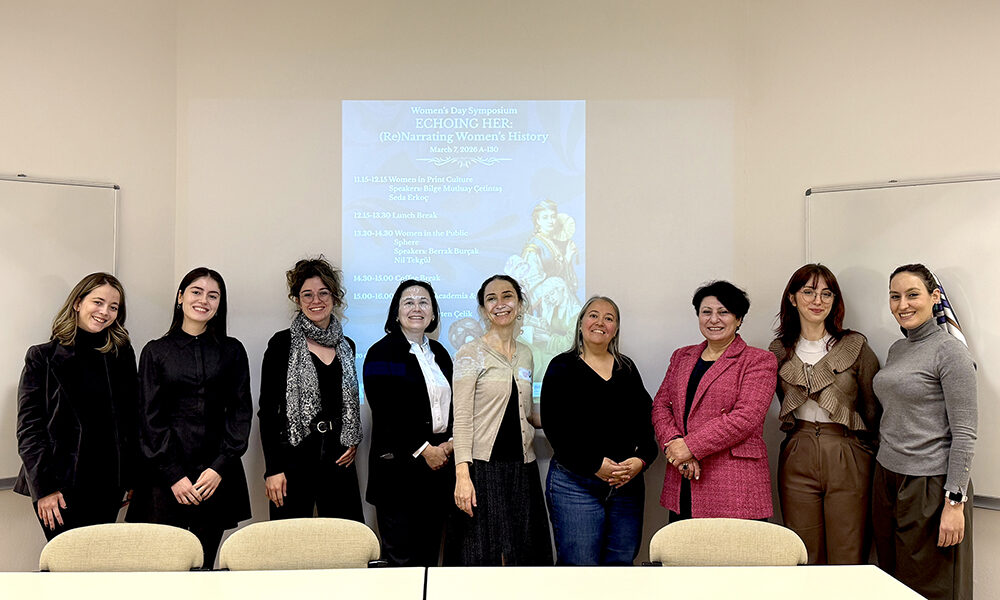

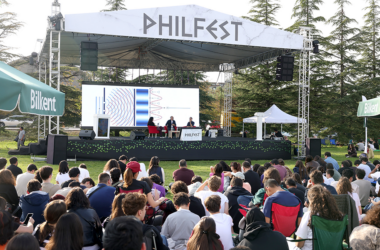
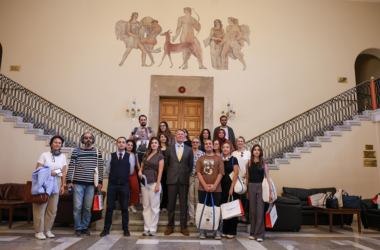
The Women’s Day Symposium titled “Echoing Her: (Re)Narrating Women’s History” took place on March 7, at Bilkent. Organized by the Bilkent Historical Society, the Department of History and the Halil İnalcık Center for Ottoman Studies, the symposium brought together scholars and students to reflect on women’s voices, experiences and roles in shaping historical narratives.
Opening remarks by Öykü Demir emphasized that women’s history is not simply about adding women to existing narratives, but about reconsidering how history itself has been written. By revisiting archives and overlooked sources, historians continue to highlight women’s active roles in shaping intellectual life, print culture and public spaces.
The first session, “Women in Print Culture,” featured Prof. Seda Erkoç Yeni (Social Sciences University of Ankara) and Professor Bilge Mutluay Çetintaş (Hacettepe University). Prof. Erkoç Yeni’s talk, “Marketing Female Conduct: Male Rivalry and Print Culture in Mid-Seventeenth-Century England,” explored how the commodification of women was reflected in print culture in early modern England. Prof. Mutluay Çetintaş presented “Anger as a Radical Force: Language in Women’s Liberation Manifestos in the USA during the 1960s,” examining how feminist manifestos used language as a political tool.
The second session, “Women in the Public Sphere,” featured Professor Nil Tekgül (Bilkent University) and Professor Berrak Burçak (Bilkent University). Professor Tekgül’s presentation, “Swaying Through the Streets: Early Modern Ottoman Women’s Struggle for Visibility and Mobility in the Public Sphere,” reconsidered the role of women’s presence in the context of the fluidity between the public and private spheres in Ottoman society. Professor Burçak’s talk, “Fatma Aliye Hanım and the Nisvan-ı Osmaniye İmdad Cemiyeti,” examined women’s associations during the late Ottoman period.
The final panel, “Women in Academia & History,” featured Professor Birten Çelik and Professor Seven Ağır (Middle East Technical University). Their discussion addressed gender dynamics within academia and highlighted women’s roles as active participants in social, legal and economic life.
The symposium concluded with closing remarks by Esra Zeynep Işık, thanking the speakers and participants and emphasizing the importance of continuing to question whose voices are heard in history. The event aimed to create a space for reflecting on women’s presence and agency in both historical narratives and the discipline of history itself.