




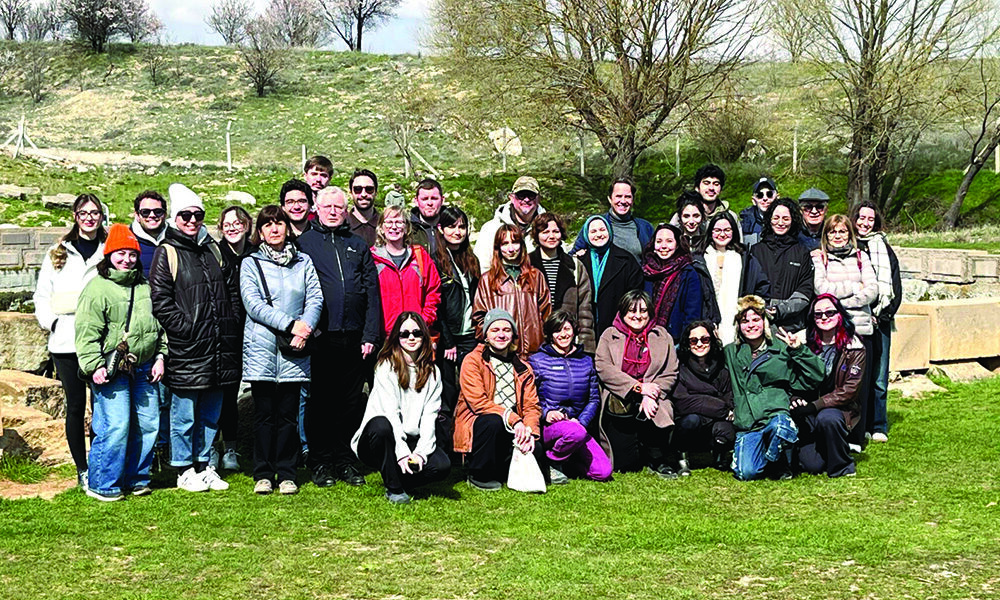
On April 11–12, 2026, the Department of Archaeology, in collaboration with the Bilkent Archaeology Club, organized a weekend trip to archaeological sites in the Konya area. Students and faculty were joined by Rector Prof. Kürşat Aydoğan and Dean Prof. Simon Wigley. The Konya Plain is of exceptional importance for its prehistoric höyük (mound) sites and is one of the best researched areas in the world, having hosted large and highly impactful archaeological excavation projects. Çatalhöyük, the first stop on the tour, is a large Neolithic site that was occupied from the 8th to 6th millennia BCE by a community of settled early farmers and herders, known for their unusual building configuration of houses set next to each other and entered by their roofs, as well as for extraordinary wall art and figurines.
The nearby site of Boncuklu Höyük dates 1000 years earlier and gives a fascinating insight into the initial experimentation of human communities within village life. The site also gives clues about the origins of later Neolithic communities as well as the domestication of plants and animals, all vital transitional processes in human history. Assoc. Prof. Emma Baysal of the department, who has worked at both sites, discussed the research achievements of the academics who have used pioneering techniques to come up with exciting new knowledge about the deep past of the area. In contrast, the site of Türkmen-Karahöyük, excavated under the aegis of Bilkent University and co-directed by Assoc. Prof. Michele Massa of the department, is a new and exciting project which promises to shed light on the Bronze Age and later occupations of the Konya Plain. This is one of the largest mound sites in the region and represents the accumulation of debris of very large settlements, likely including the one-time capital of the Hittite Empire. A large team of archaeologists and interdisciplinary specialists, including Assist. Prof. Benjamin Irvine, a bioarchaeologist who recently joined the department, has begun to reveal the important and varied information the site has to offer.
During the second day, the group explored the Beyşehir area as well as some very different landscapes. The first site of the day, Kilistra, was a late Roman and Byzantine, partly rock-cut settlement, set within a volcanic tuff landscape comparable to Cappadocia. Key features of the site are several rock-cut storage facilities, stables, dwellings and graves as well as churches that imitate built architecture. The visit highlighted the predominance of Middle Byzantine remains at Kilistra and encouraged discussion on the broader shift from the Classical city-state model to more modest yet sustainable rural settlement forms during the post-classical period.
The final stop was the Hittite sacred spring at Eflatunpınar, where a carved stone monument depicting a range of Hittite deities on ashlar blocks frames the natural spring around which the monument was based. When it was constructed, this liminal sacred spot also marked the southwest edge of the Hittite territory. Much later it was reinterpreted as part of the local belief systems that gave it its current name, Plato’s Spring, resulting from a Selçuk association between Plato and Konya, also reflected in the surrounding landscape. Some of the students performed a Hittite purification ritual while at the site and, after an unseasonably cold weekend, the sun finally made an appearance.